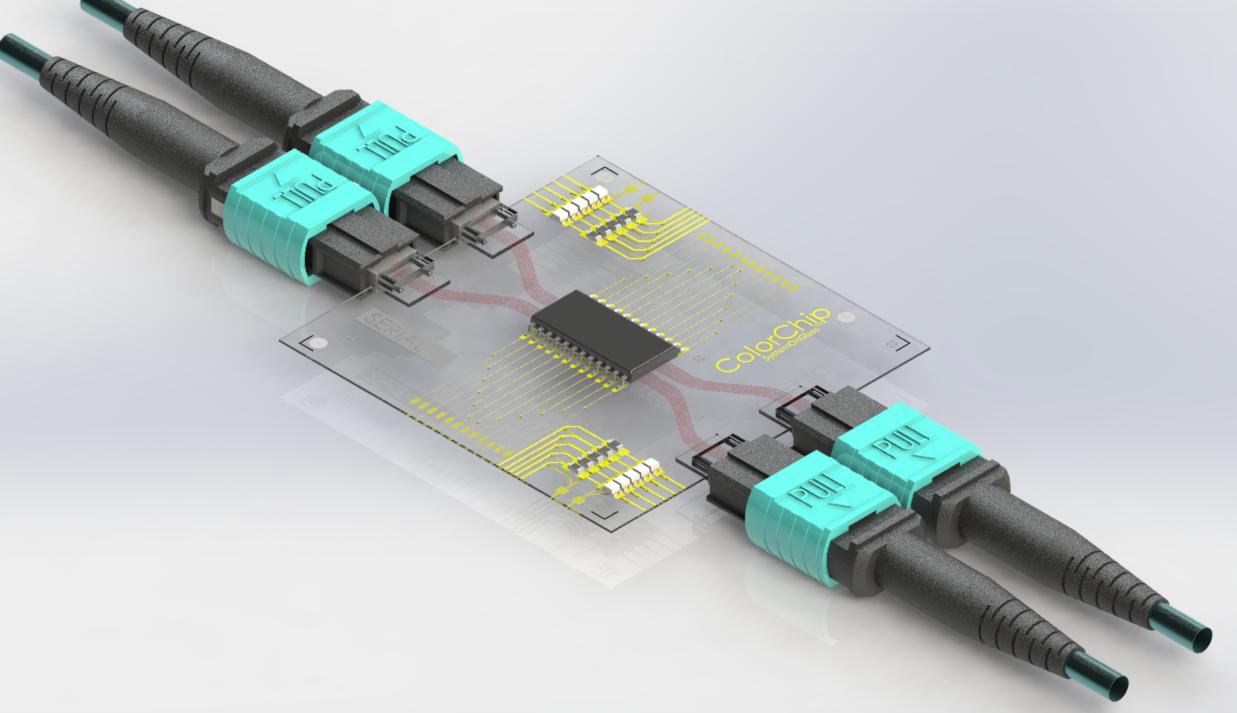
 Recently, Sioptics (Nantong) Co., Ltd. (hereinafter referred to as "Sioptics") announced the completion of its Series A+ financing round. The proceeds from this round will be specifically allocated to the introduction of Color Chip Ltd.'s globally leading ion-exchange glass-based optical wave guide technology from Israel, and to drive the intellectual property transfer and integration of its complete equipment, core patents, and manufacturing processes. According to the plan, Sioptics will officially complete the handover of all technical assets from Color Chip's Israeli facility in July this year, and fully integrate them into the company's advanced manufacturing base located in Pinghu, Jiaxing, Zhejiang, achieving domestic adoption and scaled transfer of the technological achievements.
★Building a Differentiated Optical Integration Platform Based on Core SOG Technology
Color Chip's self-developed SOG (System On Glass) technology, which originated in 2000, is an optical path integration solution based on glass substrates. After more than two decades of continuous iteration, it has achieved stable small-batch mass production. This technology directly integrates multiple active and passive optical functional components onto a glass substrate, utilizing high-precision optical wave guides to enable efficient transmission of optical signals in short-distance, long-distance, and complex topology scenarios. It offers significant advantages including high integration density, low power consumption, and low cost, forming a distinctive and competitive technological route in the field of optical communication devices.
★Unlocking MEMS Production Line Potential to Achieve Scaled Delivery of High-End Optical Devices
The core objective of this technology introduction is to fully leverage Sioptics' existing MEMS process production line's large-scale manufacturing capabilities, achieving mass production and process upgrades for ion-exchange optical wave guide technology. This production line has already demonstrated stable monthly output exceeding 10,000 IPD wafers in 2025, fully validating the company's engineering capabilities in large-scale precision manufacturing. In the first half of 2026, the company completed the expansion of several thousand square meters of clean-room facilities. Its high-end passive optical device products—including micro lens series, V-groove series, and the specialized 2D-FA multi-layer aperture plate series for OCS (optical switching systems)—have all passed rigorous certification by multiple leading customers and entered mass delivery, further demonstrating the company's system-level delivery capabilities in the high-end optical device sector.
★Filling the Domestic Gap in Glass-Based Integrated Wave-guide Technology, Building Full-Stack Glass Optoelectronics Capabilities
Xu Jianwei, Founder and General Manager of Sioptics, stated: "The successful introduction of ion-exchange optical wave guide technology, combined with the company's years of technical accumulation in TGV (Through Glass Via) via plating processes, will make Sioptics one of the few domestic comprehensive platform enterprises capable of both glass-based via interconnection and optical wave guide integration. This technology portfolio effectively fills the gap in optical wave guide functional integration among domestic TGV glass substrate companies, providing core underlying process support for next-generation high-performance optical interconnection, optical switching, and sensing applications."
Sioptics will continue to deepen its expertise in glass-based optoelectronic integration technology, driving the domestic production of high-performance optical devices for cutting-edge applications such as AI data centers, high-speed optical communications, and optical computing, contributing to supply chain self-sufficiency and industrial upgrading.